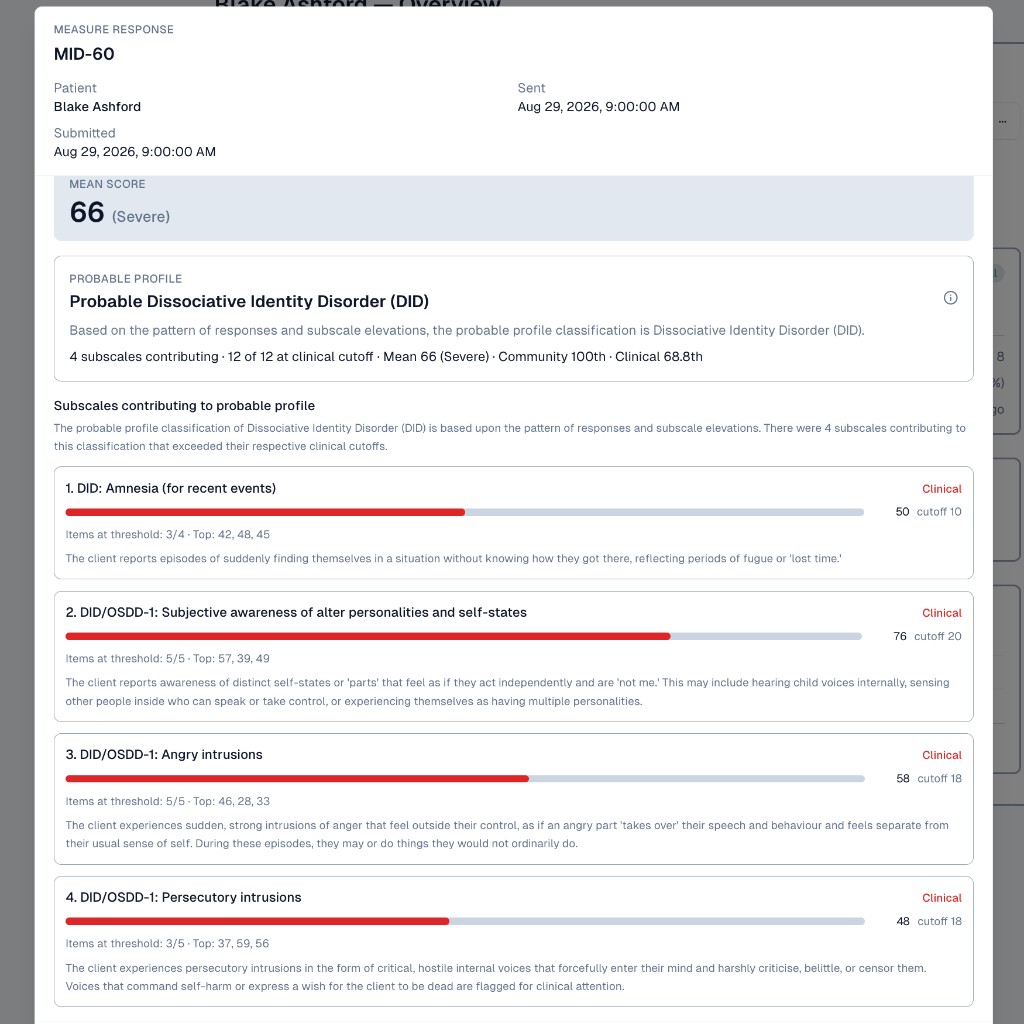
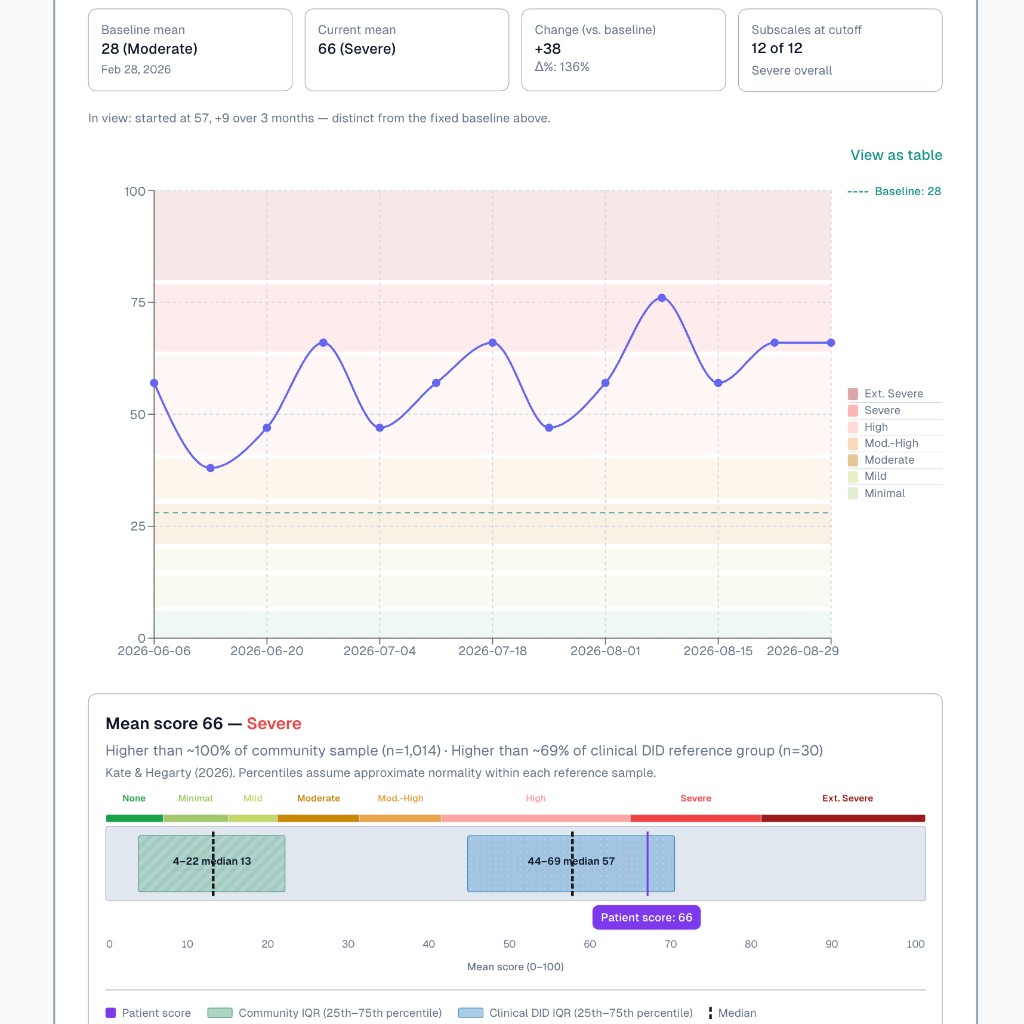
MID-60 without the spreadsheet workflow.

Send the MID-60, review scoring and profiles, keep the result with the patient's longitudinal record, and add clinical context without maintaining a separate workflow.

See the MID-60 workflow
Click to watch with sound.

For clinicians working with dissociation — not patient self-assessment.

The MID-60 workflow

  1. Step 1

    Send MID-60

    A secure patient link.

  2. Step 2

    Patient completes securely

    No patient account required.

  3. Step 3

    Review scoring & profiles

    Scoring, subscale scores, probable diagnostic profiles, percentiles, and narrative outputs.

  4. Step 4

    Track over time

    Keep administrations on the patient's longitudinal record.

Less work around the assessment

Easier administration

Secure patient link, no account, and less manual handling.

Scoring & profiles

Subscale scoring, probable diagnostic profiles, percentiles, and narrative outputs for clinical review.

Longitudinal record

Keep MID-60 administrations connected over time on the same patient record.

Clinical context

Add private clinician notes alongside the patient's record.

Convenient MID-60 scoring and interpretation

Severity, subscales, and change over time stay on the same patient record.

MID-60 results
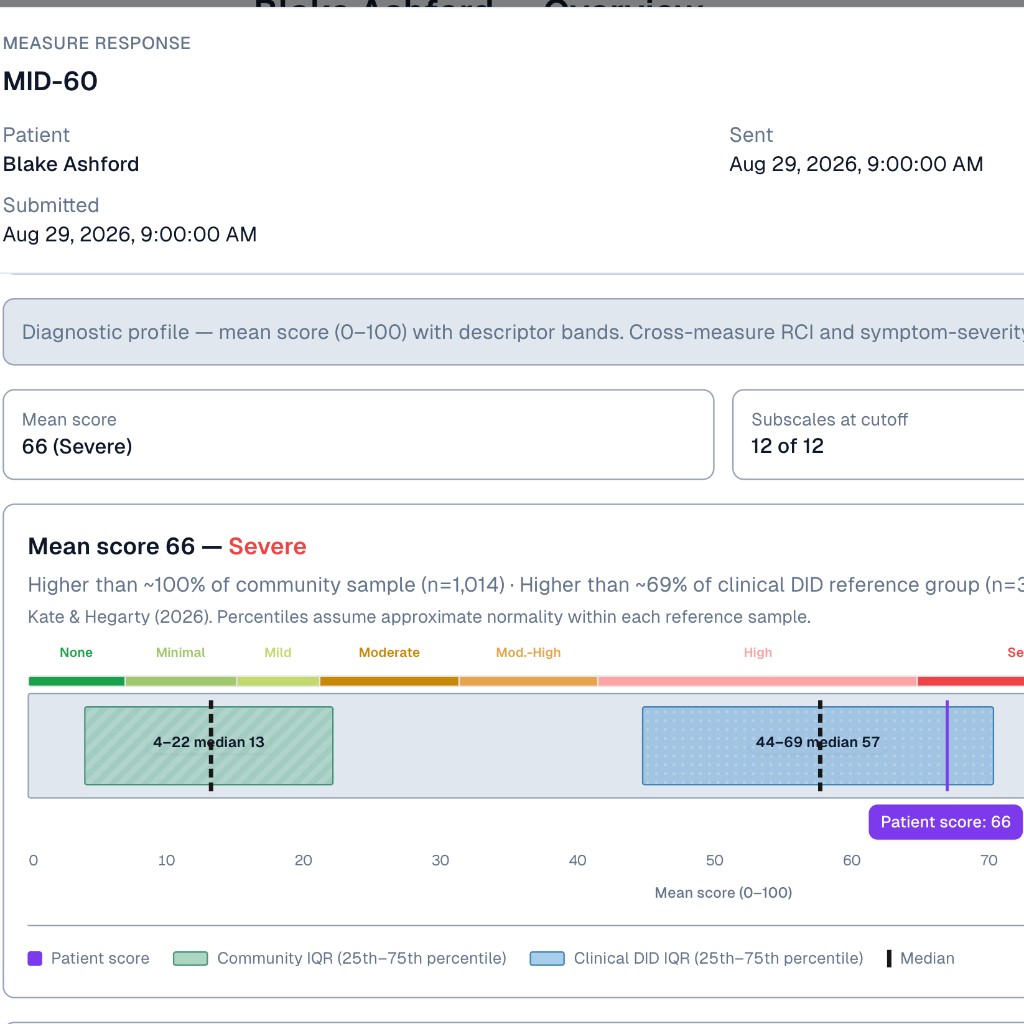
MID-60 score interpretation comparing a patient mean to community and clinical reference ranges
Score interpretation, subscales, and trending. Click a view or hover to pause.

The MID-60 doesn't have to live in a separate workflow.

Keep MID-60 results alongside other measures you already use, with patient-level trends and recurring measurement in one clinical outcomes workflow.

  • PHQ-9
  • GAD-7
  • PCL-5
  • AUDIT-C
  • DAST-10
  • Custom

Recurring protocols, patient-level trends, and practice visibility — same record.

Learn about Measurement-Based Care

Looking for the full 218-question MID?

You can send it through MBC and collect responses.

Licensing does not allow automatic scoring, so you score it yourself and enter the total on the patient record.

A simpler MID-60 workflow for your practice.

Early access is currently available to mental-health clinicians.

From clinicians

Early feedback from clinicians using MBC in practice.

MID-60

It made it really easy to onboard new patients and to interpret and score MID-60 assessments.
Independent clinical psychologist

Tracking

The best tool I have used to actually keep measurement-based care tracking going.
Independent clinical health psychologist

Protocols

The ability to quickly send a full protocol that will automatically send surveys, score and trend the results saves me several minutes each day
Clinical psychologist, MA

Dashboard

Dashboard queue is super helpful to quickly focus on the most needed patients to quickly prepare for patient interactions
Clinical psychologist, NY

Trends

I sometimes drill down into the trends per question for a few patients, and MBC's heatmap gives me really good insights
Licensed psychologist, CA

MID-60

It made it really easy to onboard new patients and to interpret and score MID-60 assessments.
Independent clinical psychologist

Tracking

The best tool I have used to actually keep measurement-based care tracking going.
Independent clinical health psychologist

Protocols

The ability to quickly send a full protocol that will automatically send surveys, score and trend the results saves me several minutes each day
Clinical psychologist, MA

Dashboard

Dashboard queue is super helpful to quickly focus on the most needed patients to quickly prepare for patient interactions
Clinical psychologist, NY

Trends

I sometimes drill down into the trends per question for a few patients, and MBC's heatmap gives me really good insights
Licensed psychologist, CA

FAQ

Mental-health clinicians who already use the MID-60 and want a simpler way to send, score, review, and keep results in the patient record. It is not a patient self-assessment service.